


If you are in immediate danger or need urgent help, Call 911 (request a youth mental health crisis-trained response if available), or contact 988 for 24/7 support. For future reference, consider saving your local crisis line now to have on hand when needed.
Welcome to the Crisis Navigator Guide & Crisis Compass Form page.
Download the Crisis Navigator Tools
The Crisis Navigator Guide and Crisis Compass Form are designed to help families feel more prepared and supported before, during, and after a youth mental health crisis. On this page, you’ll find the Youth Mental Health Opportunity Continuum, downloadable tools, and trusted resource links to help you take the next right step. The goal is to help families, schools, and communities recognize what may be happening, and connect youth to the right supports at the right time.
*In the guide and on this page, “youth” refers to children, adolescents, and young people (generally up to age 25). Support needs, services, and systems may vary by age and developmental stage.
Choose the version that works best for you. All tools are free to download.
Crisis Navigator – Quick Reference Guide
A shorter, printable version for everyday use. Includes key guidance, a completed example,
and a blank tear-off Crisis Compass Form.
Crisis Navigator – Full Printable Guide
The complete guide with in-depth information, plus the Crisis Compass Form.
Crisis Compass Form (Fillable)
A standalone fillable PDF to complete digitally, save, or print as needed.
💡 Tip: Many families start with the Quick Reference Guide and keep a completed Crisis Compass Form on hand.
This space was created to help families feel more prepared and supported before, during, and after a *youth mental health crisis.
About the Crisis Navigator Guide & Crisis Compass Form
The Crisis Navigator Guide and Crisis Compass Form are designed to work together to support families before, during, and after a youth mental health crisis.

Crisis Navigator Guide
The Crisis Navigator Guide provides caregivers with practical, trauma-informed information to help them:
-
Understand what a mental health crisis can look like
-
Recognize early warning signs and potential triggers
-
Know what steps to take during a crisis
-
Communicate effectively with youth in distress
-
Navigate available crisis supports and resources
The guide helps families feel more prepared and less alone by offering clear explanations, supportive language, and actionable guidance at each stage of the crisis continuum.
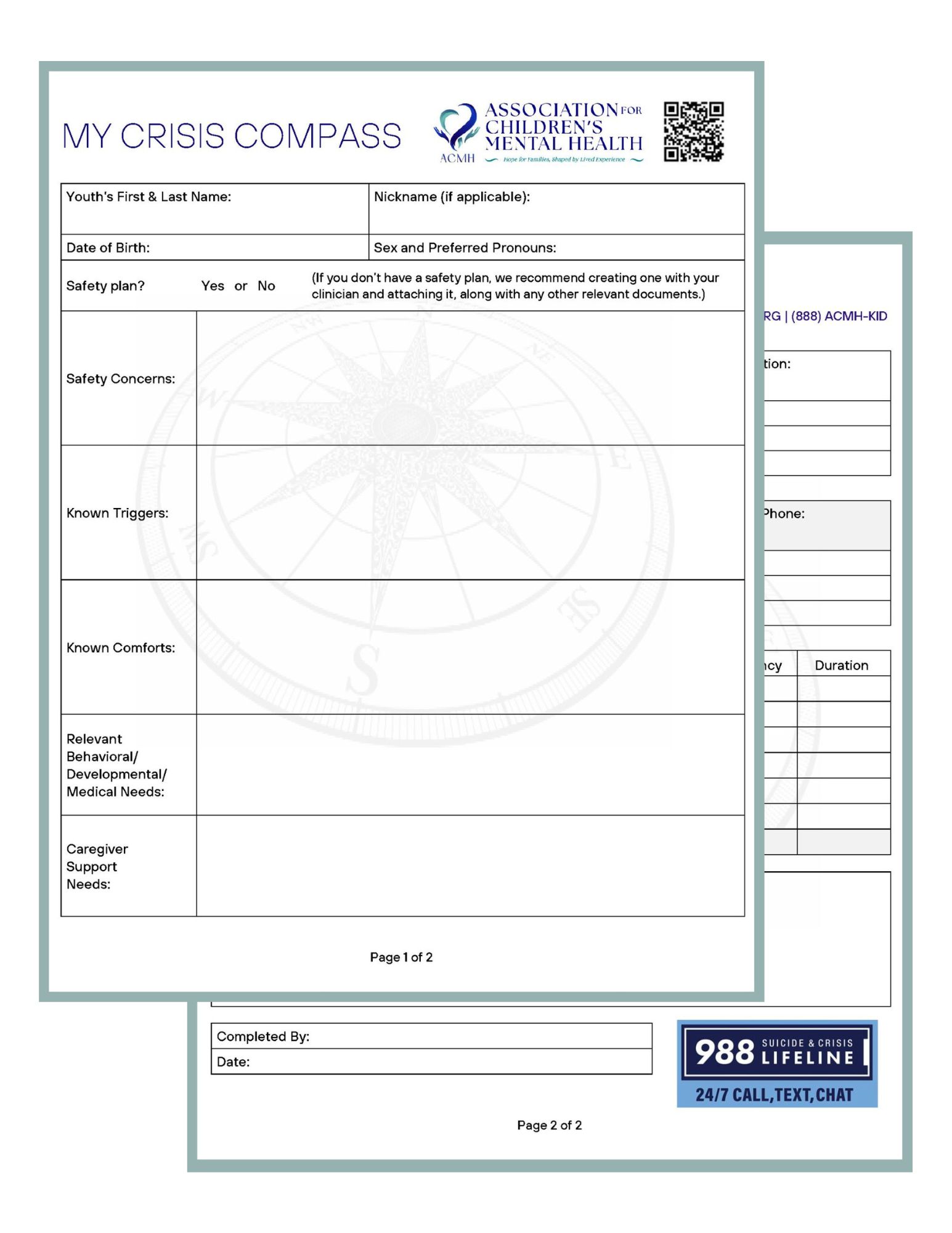
Crisis Compass Form
The Crisis Compass Form is a simple, fillable tool that helps first responders, medical staff, crisis teams, and caregivers quickly understand a youth’s needs in an emergency. It captures essential information such as diagnoses, medications, allergies, triggers, calming supports, past crisis responses, and emergency contacts. When shared during a crisis, the form can support safer, more informed, and more compassionate responses.
Best Practice
-
Complete the Crisis Compass Form during a calm moment.
-
Update it every six months or after major changes.
-
Keep copies in places you can access quickly.
How to Use These Tools Together
- Review the Crisis Navigator Guide ahead of time to understand warning signs, response options, and available supports.
- Complete the Crisis Compass Form and save a copy on your phone.
- Keep a printed copy at home or with important documents.
- Consider sharing the form with school teams, therapists, and trusted caregivers.
- Attach a safety plan if you have one (or create one with your youth’s clinician).
- Bring the form with you when accessing crisis services or going to the emergency room.
Why This Matters
During a crisis, it can be difficult to remember details or explain your youth’s needs clearly. Having information prepared in advance helps reduce stress, saves time, and allows responders to focus on safety, understanding, and support.
Get Started with the Crisis Navigator Tools
Below are downloadable versions of the Crisis Navigator Guide and Crisis Compass Form. You can choose the format that works best for you—whether you want to read the guide, complete the form digitally, or print copies to keep on hand.
-
Download the Crisis Navigator Guide (Full Guide + Crisis Compass Form)
A comprehensive, printable guide that includes background information, warning signs, crisis response steps, and the Crisis Compass Form. -
Download the Crisis Navigator – Quick Reference + Compass Form
A shorter, print-friendly version designed for quick review and easy sharing. -
Download the Crisis Compass Form Only (Fillable PDF)
A standalone, fillable version of the form that you can complete on your device, save, and print as needed.
Tip: Many families find it helpful to review the guide first, then complete the Crisis Compass Form during a calm moment.
Understanding the Youth Mental Health Opportunity Continuum
The continuum shows how a young person’s mental health can shift over time, and where support can make the biggest difference. Youth may move back and forth along the continuum. Support is valuable at every stage, not just during a crisis.
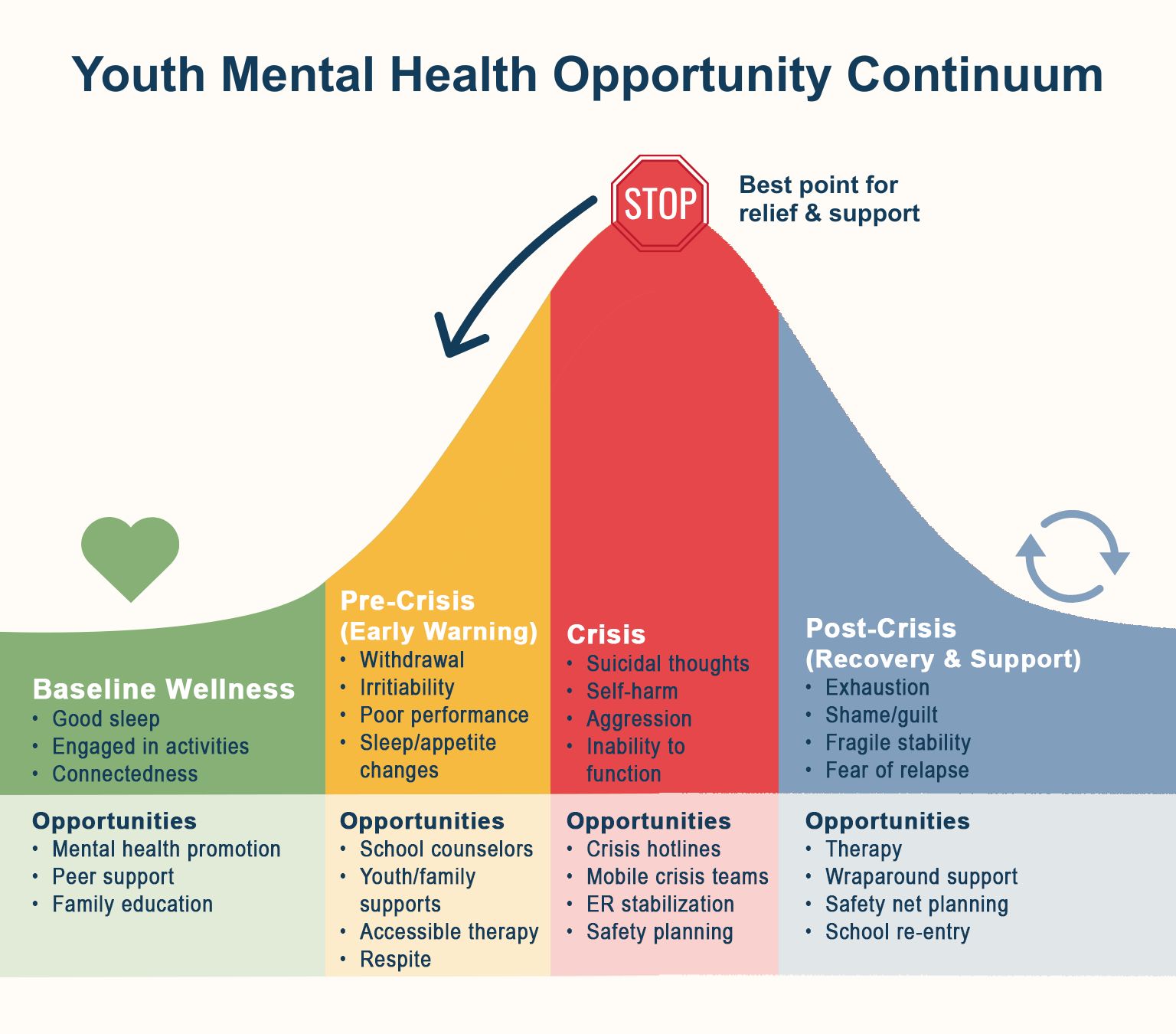
🟢 Baseline Wellness
- Youth are generally doing okay, sleep, activities, and connection are more stable. It’s important to note what indicates “Baseline Wellness” for your youth to recognize and know the signs that are outside the realm of what is considered “well” for your youth.
- Supports may include mental health promotion, peer support, and family education.
🟡 Pre-Crisis (Early Warning Signs)
- Early changes may include withdrawal, irritability, changes in sleep or appetite, or declining school performance.
- This is a key window to step in with counseling, accessible therapy, youth/family supports, and respite.
Tip: Many health insurance cards list a mental or behavioral health phone number on the back. If you don’t see one, call the main member services number and ask for behavioral health support.
You may also have help through your employer. Many workplaces offer an Employee Assistance Program (EAP) or other mental health resources that provide free, confidential support and help finding services for employees and their families.
🔴 Crisis
Crisis is a period when a youth may face urgent safety concerns, such as suicidal thoughts, self-harm, aggression, or an inability to function in daily life.
During these moments, immediate support can help reduce risk and keep everyone safe.
- In Michigan, families have access to multiple crisis response options, including 988, local crisis and access lines (MiCAL), mobile crisis teams, and crisis stabilization services.
- These supports can help assess safety, provide de-escalation, and connect youth and families to appropriate next steps.
Important: A crisis does not mean failure. It is often the point when families finally receive support, but effective care starts before a crisis and continues after one. Ongoing follow-up, recovery supports, and early intervention are just as important as emergency response.
Note: This stage often brings the most urgent need for relief and support, but it is not where support should begin or end.
🔵 Post-Crisis (Recovery & Support)
- After a crisis, families may experience exhaustion, fear of relapse, shame/guilt, or fragile stability.
- Ongoing care may include therapy, wraparound supports, safety planning, and school re-entry supports.
Why This Matters
- Mental health needs are not “all-or-nothing.”
- Early support can prevent crises.
- Recovery takes time and continued support.
- Families deserve support before, during, and after a crisis.
Recognizing Warning Signs
Warning signs can show up in different parts of a young person’s life. Trust your instincts, if something feels “off,” it’s okay to reach out for support.
- Emotional / behavioral: mood swings, irritability, withdrawal, anger outbursts.
- Verbal / written: hopelessness, talk of death, feeling like a burden.
- Academic / social: sudden drop in grades, skipping school, isolating from friends.
- Physical / daily functioning: changes in sleep/eating, low energy, neglecting hygiene, risky behaviors.
When to Seek Immediate Help
If a youth is talking about suicide, has a plan, has access to means, is self-harming in a life-threatening way, or you are unsure about safety, seek emergency help right away.
Call 911 (request a youth mental health crisis-trained response if available), or contact 988 for 24/7 support.
What to Do During a Crisis
1) Stay calm and supportive
- Use a steady, reassuring voice.
- Validate feelings: “I hear you, and I want to help.”.
- If there is suicidal thinking or severe distress, do not leave them alone.
2) Reach out for help
3) Prioritize physical safety
- Remove harmful items if possible. (medications, weapons, sharp objects, ligatures)
- Move to a quieter, safer space.
- Seek medical care if self-harm has occurred.
Quick Help Resources
24/7 Crisis Support
Michigan-Specific Crisis Support
- MiCAL (Michigan Crisis & Access Line):
mical.michigan.gov - MPCIP Crisis Resource Directory:
mpcip.org/crisis-directory - ACMH Parent Line: (888) ACMH-KID (226-4543) | [email protected]
What to Say (and What Not to Say)
- Try: “I see you’re struggling, and I want to help.”
- Try: “Can you tell me what’s on your mind?”
- Avoid: “You’ll get over it.”
- Avoid: “You’re doing this for attention.”
Need Help or Have Questions?
If you have questions about using the Crisis Navigator or Crisis Compass Form, or need help finding support, our team is here.
Feedback, Questions, or Updates
Have feedback on the Crisis Navigator Guide or Compass Form? Want to share ideas, ask questions, or receive updates when resources change?
Your input helps us improve these tools so they better support youth, families, and communities.
We gratefully acknowledge the many parents, caregivers, first responders, law enforcement officers, medical professionals and mental health advocates who shared their insights and experiences to help shape this guide. Your contributions ensure that families and communities have the knowledge and resources needed to respond to a crisis with care and understanding.