






Parent Support Partner
Parent Support Partners bring lived experience into the mental health system, helping parents and caregivers find their voice, build confidence, and navigate services alongside their child.
Access the PSP Portal
If you are a Parent Support Partner or Supervisor, you can log in here and enter your username and password. Once you are logged in, click here to enter the portal.
Get Started with PSP
Community Mental Health agencies and contract service providers interested in bringing Parent Support Partner services to their community can learn about the process here.
Peer Support Questions
Have a question about the Peer Support Program, Youth Peer Support, or Family Crisis Response Peer? Tell us a little about what you’re looking for, and our team will connect you with the right information.
Parent Support Partner in Michigan
Michigan’s Parent Support Partner model is a statewide initiative in partnership with the Michigan Department of Health and Human Services that provides Medicaid-reimbursable peer-to-peer parent support to eligible families as a part of Michigan’s Early Periodic Screening, Diagnosis and Treatment State Plan.
ACMH provides statewide coordination for the project in the form of certification, training, and ongoing coaching, supervision, support, and technical assistance.
The Parent Support Partner (PSP) service is an intervention that supports families whose children receive services through a community mental health service provider.
The purpose of the Parent Support Partner Service is to increase family involvement, voice, and engagement within the mental health treatment process and to equip parents with the skills necessary to address the challenges of raising a youth with special needs, thus improving outcomes for youth with serious emotional disturbance and/or intellectual/developmental disabilities, including autism, involved with the public mental health system.
The PSP service is provided by parents or primary caregivers with first-hand experience navigating public child-serving agencies and raising a child with mental health or developmental challenges. Support provided to a family by a PSP focuses on increasing confidence as parents find their voice when partnering with service providers and empowers parents to develop sustainable, natural support networks after formal service delivery has ended.
Parent Support Partners, serving as an equal member of the treatment team, assist in identifying goals within the Family Centered Plan that support parents in finding their voice and confidence in parenting a child with serious emotional disturbance (SED) and/or intellectual/developmental disabilities (I/DD), including autism.
Parent Support Partners enhance the therapeutic process by increasing engagement and expanding skills, knowledge, and abilities so families can better partner with service providers.
What Exactly Do Parent Support Partners Do?
Peer-Delivered Support
Provide peer-delivered support to parents and primary caregivers of children and youth with SED/I/DD, including autism, in the public mental health system.
Family Voice & Choice
Support parents in identifying services that are meaningful and beneficial for their family and encourage them to speak for themselves and make informed decisions.
Communication & Collaboration
Demonstrate effective communication and collaboration while helping parents build confidence to use their voice as they navigate child-serving systems.
Family Partnership
Work individually with families whose children are receiving CMH services to provide additional support and skill building for partnering with service providers.
Relationships & Connection
Build and nurture relationships with families and others working with the family while providing hope through strategic sharing of lived experience.
Planning & Participation
Support parent and primary caregiver participation in family-driven, youth-guided practices, including development of a plan of service, treatment, goals, and services and supports.
Team Partnership
Team with others providing services and supports and help bridge the relationship between parents and professionals.
Meeting Preparation
Empower parents to prepare for meetings regarding their child and encourage families to ask questions so they can make informed decisions about what is best for their child and family.
Benefits of Parent Support Partner Services
What Does Research Say About Parent Support Partner Services?
Peer support research has identified six main areas of improvement when families are connected to peer-to-peer parent support.
What Is Involved in the PSP Certification Process?
The Parent Support Partner certification model requires that Parent Support Partners participate in five full days of classroom training, ten months of individual and group coaching, and quarterly Professional Development and Technical Assistance meetings.
Classroom Training
Classroom training topics include Family Driven & Youth Guided Care, Cultural Competency, Child and Family Serving Systems, Confidentiality, Mandated Reporting, HIPAA, Boundaries, Roles and Function of Parent Support Partners, Benefits of the Service, SMART Goals, Parent-Professional Partnerships and System of Care, and an overview of child and family service systems.
Monthly Group Coaching
Monthly Group Coaching calls are facilitated by a member of the training and coaching team and offer an opportunity to teach, share, and demonstrate competencies through dialogue and consultation.
Individual coaching is also available upon request from the PSP or recommendation from the Coach, PSP Coordinator, or CMH Supervisor. Individual coaching can be used to refine skills in a specific skill area and provide targeted technical assistance related to particularly challenging needs.
Professional Development Meetings
Professional Development Meetings are held quarterly, and Parent Support Partners meet face-to-face or virtually for ongoing learning. These meetings provide opportunities for networking with other PSPs and technical assistance around barriers to implementing the model with families and professionals.
Supervision
Supervision of Parent Support Partners is provided by a CMH Qualified Mental Health Provider who:
- Has direct knowledge and contact with families receiving PSP services.
- Provides clinical direction related to treatment goals.
- Supports clinical staff to integrate PSPs into the treatment team and development of goals.
What Is Required of Community Mental Health Agencies?
Community Mental Health Service Providers who wish to employ Parent Support Partners are expected to:
Key Expectations of the Program
There is an expectation that the Parent Support Partner Service will be an intervention-based service and attached to a treatment goal.
There is also an expectation that PSPs will be integrated into the treatment team and be an identified service within the Family Centered Plan to provide support, information, skill development, and resources to families to accomplish the treatment goals being targeted.
Parent Support Partners will work in partnership with the therapist and treatment team to assist families, bridge the relationship between parent and professional, and support family and youth voice.
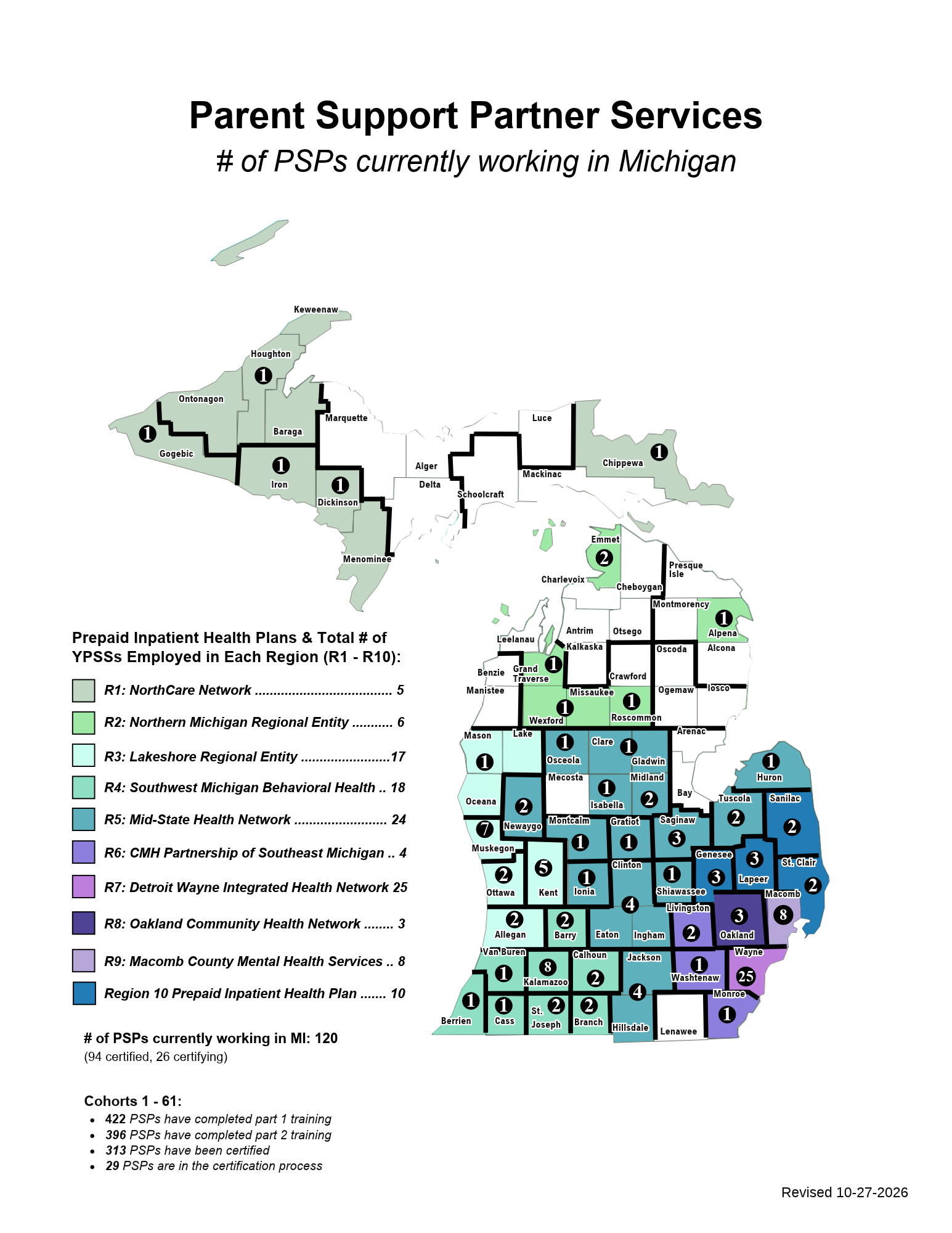
Parent Support Partners in Michigan
Parent Support Partners are part of communities across Michigan, bringing lived experience and peer support into the behavioral health system.
PSP Program Resources
Training Calendars
View the current training schedule for Parent Support Partners.
Previous Annual Reports
Explore archived Parent Support Partner annual reports.
Questions?
Connect With Us
Have questions about Parent Support Partners, training, certification, or bringing the service to your community? Our team can help point you in the right direction.
Leave a Reply
You must be logged in to post a comment.